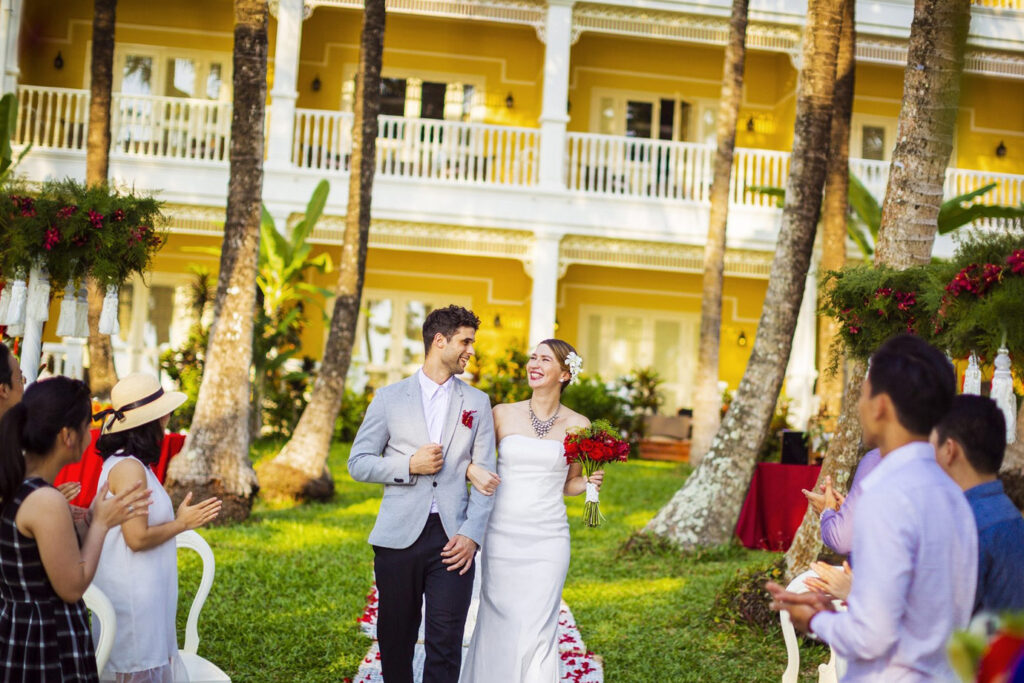
Imagine exchanging vows on a pristine beach in paradise, the gentle waves whispering blessings as you embark on your journey of lifelong commitment. Picture a celebration infused with the vibrant colours and rich traditions of Vietnam, creating an unforgettable experience for you and your loved ones…At La Veranda Resort in Phú Quốc, we transform dream weddings in Vietnam into reality. Nestled amidst lush tropical gardens and overlooking the turquoise waters of the Gulf of Thailand, our resort offers an idyllic setting for your special day. With our dedicated team of wedding planners, bespoke services, and exquisite venues, we’ll ensure your Vietnam wedding is as unique and unforgettable as your love story.
Why Vietnam is an Exceptional Wedding Destination
Vietnam, with its captivating blend of natural beauty, cultural richness, and warm hospitality, is an enchanting destination for romantic weddings. If you would like to spend your wedding day in paradise with all of your favourite people surrounding you, Vietnam is the place! Here’s why:
Scenic Landscapes: From pristine beaches and verdant rice paddies, to majestic mountains and bustling cities, Vietnam offers a diverse range of backdrops for your dream wedding.
Cultural Charm: Embrace the rich traditions and customs of Vietnam, adding a touch of authenticity and uniqueness to your celebration.
Warm Hospitality: Experience the genuine warmth and hospitality of the Vietnamese people, ensuring a welcoming and memorable experience for you and your guests.
Gastronomic Delights: Tantalise your taste buds with the vibrant flavours of Vietnamese cuisine atLa Veranda’s restaurants, from fragrant pho and fresh spring rolls, to aromatic curries and delectable seafood.
Affordable Luxury: Enjoy world-class amenities and services at a fraction of the cost compared to other popular wedding destinations.
The Ultimate Beachfront Venue for Intimate Weddings at La Veranda
Ourvilla resort in Phú Quốc offers the perfect setting for anintimate beachfront wedding. Exchange vows on the soft sands, surrounded by the soothing sounds of the ocean and the gentle breeze. Our dedicated team will transform the beach into a magical haven, with elegant décor, personalised touches, and an impeccable service.Imagine:
A flower-adorned archway framing your silhouette against the setting sun.
The soft sand cushioning your feet as you exchange vows.
The gentle sea breeze carrying your promises of forever.
A candlelit reception under the stars, with the sound of waves serenading your celebration.
Customisable Vietnam Wedding Packages for Every Couple
We understand that every love story is unique. That’s why we offer a range of customisable Vietnam wedding packages to suit your individual preferences and needs. Whether you envision a traditional Vietnamese ceremony, a Western-style celebration, or a fusion of both, our team will work closely with you to create a bespoke experience that reflects your vision.
Stress-Free Planning with Professional Coordination
Planning a wedding, especially a destination wedding in Vietnam, can be a daunting task. At La Veranda, we take the stress out of the process with our dedicated wedding planning team. Our experienced coordinators will handle every detail, from venue selection and décor, to catering and entertainment, ensuring a seamless and unforgettable celebration.Relax and enjoy your special day, knowing that every aspect is in expert hands.Blending Local Culture with Personal TouchesAt La Veranda, we believe in creating weddings that are both unique and authentic. We encourage couples to incorporate elements of Vietnamese culture and traditions into their celebrations, adding a touch of local charm and creating a truly memorable experience.Whether it’s a traditional tea ceremony, a vibrant Ao Dai dress, or a performance of traditional Vietnamese music, we’ll help you weave cultural elements into your wedding, creating a beautiful fusion of heritage and personal style.
Plan Your Perfect Wedding at La Veranda Resort
Embrace the romance and enchantment of a destination wedding in Vietnam.Contact La Veranda Resort today to begin planning your dream Vietnam wedding. Our team is ready to assist you in creating a celebration that effortlessly tells your unique love story.Experience the magic of Phú Quốc island, where natural beauty, cultural richness, and exceptional hospitality converge to create an unforgettable, romantic wedding experience!
Array
Find Out More
Cities to visit in Vietnam
Adventurous and developing, this narrow country between the Cambodia and Laos borders, definitely impresses myriad different ways. With profound natural beauty, characterized by forested mountains, pristine beaches, scenic valleys, lush rice terraces, charming karst formations on the north, and a fertile delta on the south, Vietnam has the power to inspire awe.
Despite its struggles, being ruled for nearly a millennia by many different Chinese dynasties before it became a French Protectorate in the 1800s and prior to experiencing a brutal and fierce war, it now stands proudly and switches gears into becoming a rapidly developing nation. The places to visit in advancing Vietnam are, literally, endless. But, if one had to pick just a handful of them, these would be:
Duong Dong
Duong Dong is one of the most developed cities in Vietnam and the main town on Phu Quoc Island, also known as Pearl Island, ready to offer holidaymakers a VIP experience if only they ask for it. Often called “the heaven on earth” Phu Quoc is home to unimaginable beauty, characterised by sugary beaches, pristine shores, incredible views of the ocean, a rich marine life, crystalline waters, cloudless skies, and jungle-like forests; and Duong Dong is the embodiment of all this allure.
Staying here comes with several benefits, as you have the opportunity to live life like a local and, at the same time, enjoy modern comforts. For that reason, you will find luxury resorts like La Veranda, whose high-end facilities, conveniences, spellbinding panoramas, and proximity to the main attractions, such as the Cau Temple, the Duong Dong night market, and award-winning restaurants, make it one of the most favourite beachside hotels among individuals, couples, and families that satisfy with nothing but absolute splendour.
Dalat
Dalat is a city that many French colonials and Vietnamese emperors used as a summer retreat. Can you blame them? Colourful flowers everywhere, verdant land, beautiful French colonial architecture, the scent of pine trees swirling in the air, and misty valleys treating the eyes of every weary traveler can make anybody fall in love with the place. Conveniently situated in the South Central Highlands of the country, it is a great escape for those in search of a refreshing area to chill out and cool off while pampering themselves with mind-blowing vistas.
My Son
If you love visiting sites of archaeological interest, then My Son will tick all of your boxes. Nicely tucked near Duy Phu village on the central coast of Vietnam, it is one of the most significant ancient sites that speaks of a glorious past. My Son was once a religious centre for Hindu ceremonies and attracted the attention of the king of the Champa Kingdom, who built temples here to honour Shiva, one of the three chief divinities of the Hindu Triad, between the 4th century and the 1300s.
Ho Chi Minh City
Nestled near the Mekong Delta along the Saigon River, Ho Chi Minh City occupies a special place in southern Vietnam. Previously referred to as Saigon, it used to be the centre of administration during the Vietnam War. Over the years, it took its place as the largest city of the country, giving tourists and Vietnamese alike many reasons to step foot on its land as it combines the modern and the traditional lifestyle so harmoniously, offering from a vibrant night scene to historical attractions.
Kon Tum
The north of Vietnam is not as developed as the southern regions, but places like Kon Tum make it worth exploring. Situated along the Dakbla River up in the central highlands of the country, Kon Tum is a spirited town following a more laid-back way of living. This quiet and peaceful green dot on the map is not widely known among tourists, which enables those that wish to soak in the local culture to experience exactly that.
Mekong Delta
Nicknamed Vietnam’s Rice Basket, The Mekong Delta is a pole of attraction for its fertile land and the labyrinth-like streams and canals that feed it. This sheer agricultural region extends from Ho Chi Minh City and goes all the way to the Gulf of Thailand, providing food via its rich rice paddies, plantations, and fish farms to more than 30% of the country. Besides rice paddies and floating markets, the Mekong Delta is also home to bird sanctuaries, sugar cane groves, fruit orchards, and Instagram-perfect fishing villages.
Nha Trang
The main draw of this lovely seaside resort town is its beach which is surrounded by a heart-stopping promenade, palm trees, hot springs, and beautiful resorts. Found off the coast of South-Central Vietnam, it features one of the most mind-blowing bays in the country and diverse marine life, along with pictorial mountain ranges, sandy beaches, a mesmerising sea bed, water parks, healthy reefs, and gorgeous seascapes. The coastal town is full of Catholic churches, Champa Kingdom temples and architecture, and Vietnamese eateries. No wonder it is so favoured by tourists and scuba divers that flock from all over the country (if not the world) to explore its beauties.
Sapa
Between rice terraces and rolling hills lies Sapa, a picturesque town in the remote northwest of the country. This isolated, quiet place is surrounded by a wide range of mountain tribes that makes a perfect starting point for trekking enthusiasts, who hike up the imposing Hoang Lien Son Mountains or tour traditional villages and rice paddies that come in abundance around here. On their way, they go past majestic waterfalls while also being provided with the chance to learn the local way of life, taste traditional Vietnamese food, and familiarise themselves with local customs.
Hue
Central Vietnam hides a gem called Hue whose citadel is an attraction on its own as it comprises of magnificent gates, palaces of incredible grandeur, and temples so elaborate that they create an unpretentious feeling of astonishment. The town that once served as the imperial capital of the Nguyen Dynasty and seat of Nguyen emperors sits on the banks of Perfume River, narrating its glorious past through every aspect of its being, from the cuisine and culture to architecture. Its official symbol is the Thien Mu Pagoda; another sight for sore eyes.
Hoi An
A few kilometres off the coast of the South China Sea, the old city of Hoi An is already living through its second millennia. Tracking it back to the Champa Kingdom, some 2,000 years ago, the south-central town is a popular destination among people looking for relaxed, unique experiences infused with a local flair. Tourists love strolling the atmospheric Old Town in the heart of the city with the maze-like streets. Adorned with beautiful architecture and offering the opportunity to taste traditional flavours and go shopping, Hoi An knows how to please the discerning tourist.
Ha Noi
One of its most prominent landmarks is the open-air museum of historic French colonial and Asian architecture, namely Old Quarter, which stood the test of time almost in its entirety despite the Vietnam Wars and the bombings that threatened its existence. Those that have been here admitted feeling enchanted by the overall paradisiac sensation, with the cosy cafes, charming markets, and striking tree-lined boulevards. Don’t leave without visiting the Saint Joseph Cathedral, Presidential Palace, and the Grand Opera House!
Ha Long Bay
With limestone rock formations emerging from the sea like mythical monsters, and waters so clear and cobalt that become one with the sky, Ha Long Bay seems like a place that has popped out of a fairy tale. As you look around, you will be able to see the overwhelming natural beauty of a landscape dotted with lakes, hundreds of lush forest-covered islands carved by the hand of Mother Nature, and fascinating caves. A fantastic speck of land indeed, some 130 kilometres east of Hanoi!
Vung Tau
If you are like the majority of people flocking this town, you will catch a hydrofoil boat from Ho Chi Minh City and head to Vung Tau for a short, relaxing break. You can spend carefree holidays while exploring the peninsula stretching around Vung Tau, enjoying your cocktail at a local bar, and pampering yourself with some Vietnamese delicacies while the little ones run around the shore having fun. This lovely town that once was colonised by the French is now a favourite weekend destination worth stopping by.
Haiphong
Unlike its neighbouring cities, Haiphong is an industrial town experiencing profound growth in the last few years. Nevertheless, it still amazes with its colonial architecture and unique features that make it stand out against other industrial cities of the north. Strolling its streets will enable you to view the fantastic flame flower trees along every road. Walk a bit more up the Halong Bay, and you will be rewarded with cinematic views, a sandy beach ready to offer you unique moments of composure, and streets lined with spectacular shrines, temples, and pagodas.
Ha Giang
Most people visiting Ha Giang feel as if they have made a trip back in time. Being one of the lesser touristy cities of the North, sitting comfortably in the banks of Lo River, Ha Giang has a mystical vibe. Be it the mysterious mountains encircling it, the sweeping valleys that many ethnic minorities call home, the winding hills all around, or the lively markets that are packed with sellers offering handmade goods, fresh food, and animals every Sunday, one thing is for sure. Ha Giang’s cultural heritage and allure are unsurpassable.
Cao Bang
Verdant hills occupied by different ethnic tribes, jetting waterfalls whose waters meet with the swirling Bang Giang River, and blooming valleys consist the backdrop of this beautiful part of Vietnam. Here, you will see women coming from small nearby villages to sell their fresh produce in the local markets of this pastoral paradise.
Dong Hoi
Somewhere between south and north Vietnam is Dong Hoi, a city that has suffered a great deal during the war with the USA. It was nearly destroyed and then rebuilt to become a prestigious destination along the coast that attracts hundreds and thousands of tourists that love it for its fine-sand beach, crystal clear waters, and enchanting underwater ecosystem. Over the years, it has seen its seashores occupied with more and more small hotels and restaurants offering delicious seafood. Those that visit Dong Hoi also adore it for the long list of adventurous endeavours they can try in the surrounding areas, exploring the mystical Phong Nha Cave networks being one of them.
Can Tho
Can Tho is famous for its floating markets, where one can find a plethora of merchants (even coming from the connecting Mekong Delta) trading goods, including food, on the convergence of the Hau and Can Tho rivers, which basically feed this city one way or another. Some locals like to call this town the rice bowl of Vietnam. Can you blame them? The fish, rice, and fresh veggies that comprise the raw materials of the town’s restaurants are all traded through the city. This means that if something is guaranteed around here is that you will treat your palate with mouth-watering tastes. As for the evenings, the idyllic sunsets and star-lit sky turn this place into a dreamland that hosts friendly locals and guests that enjoy relaxed vibes.
Hue
Another town that was once Vietnam’s imperial capital and home to the governing class. Unfortunately, most parts of its radiant Imperial Palace was completely damaged during the war with America. The remaining ruins are reminders of a once glorious city (though some sections of the palace are still intact) and attract the interest of history fans who make a stop here and explore the area, which also encloses tombs the emperors had self-built and some excellent dining facilities alongside the Perfume River.
Wherever you look, you will find cities crammed full of colonial architecture, creativity, and culture with great appeal and magnetism. Depending on what you wish to experience coming in Vietnam, there will always be a town to meet your unique requirements, from bustling, motorbike-filled hubs to towns with historical heritage, sparkling beaches, exclusive resorts, winding waterways, lush greenery, or floating markets. And, as they continue to push into the future, they will surely have lots more to impress the world with.
Island Escapes on a Budget: Unveiling the Best Phu Quoc Deals and Discounts
When we daydream of our perfect paradise island escape, we are often abruptly halted by thoughts of the cost or other implications standing in our way. However, we are here to tell you that these daydreams are far more within your grasp than you may think. If you want absolute luxury in a private and tranquil location steeped in history, you need to see what Vietnam hotel deals are available in Phu Quoc. At La Veranda, we have a selection of Phu Quoc vacation offers that promise to provide our guests with everything they need to create their dream getaway.
Unbeatable Phu Quoc Deals.
One of the most wonderful things about the deals you come across at luxurious Phu Quoc resorts is that you will never compromise the quality, opulence, and blissfulness of your dream island escape. Our special offers are tailored to accommodate everyone who wants to bask in the tranquillity of this incredible island. From wellness and gastronomy packages to unbelievable deals on private beachfront villas, you are sure to find exactly what you are looking for at our resort in Vietnam.
The Best Time to Find Phu Quoc Hotel Deals
If you’re looking for the best possible Phu Quoc hotel deals, you can sometimes find offers that seem too good to believe by being mindful of the time you choose to visit. Phu Quoc’s high season is between December and April, but you’re highly likely to get brilliant weather either side of these months, too. If you’re looking for fantastic Phu Quoc vacation offers, feel free to chat with the team at La Veranda to find the perfect one for you.
Finding the Perfect Phu Quoc Resort
Phu Quoc is home to many resorts, so it is imperative to know you’re booking the right one for you. La Veranda offers a wide range of suites and villas, either nestled within the serenity of our diverse gardens or perched on the oceanfront for the most captivating sea views. We also have several restaurants and bars situated on the grounds of our 1920s French colonial-inspired mansion. To top it off, we have a wellness centre that allows our guests to truly unwind. Our Phu Quoc hotel deals are guaranteed to have a package for everyone.
[ux_image id="9085" margin="20px 0px 20px 0px"]
Affordable Activities in Phu Quoc for Travelers on a Budget
Phu Quoc is quite possibly one of the most beautiful islands in the Thai Gulf, and what adds to its magnificence is its tremendous size. This glorious island boasts an enormous selection of activities, so you will never be stuck for something to do. We are home to the world's longest cable car and an awe-inspiring European-style town in the south where you can enjoy a day of diving and snorkelling. In the north of the island, we have beautiful beaches, seaside towns, theme parks, museums, and markets. If you’re looking for the perfect day out, there are some incredible Phu Quoc travel offers that can make every day of your vacation a day to remember.
Savouring Phu Quoc's Culinary Delights Affordably
If you want to experience the unique and delicious cuisine of Phu Quoc, you will be spoiled for choice. Endless bars and restaurants are dotted around Duong Dong and Truong Beach. Here, you will have a chance to enjoy some of Phu Quoc’s classics, such as bún quậy and grilled sea-urchin. Or, if you’re looking for a relaxing night at your resort, La Veranda has multiple deals, such as our gourmet Xin Chao or gastronomy package. You will be spoiled for choice in our bars and restaurants when you experience our Phu Quoc vacation offers.
[ux_image id="9086" margin="20px 0px 20px 0px"]
Phu Quoc Hotel Deals for Groups and Families
If you are looking for Vietnam hotel deals to accommodate a group or family, Phu Quoc has you covered. At La Veranda, we have some fantastic comprehensive packages that are fit for all parties. Have a browse through our holiday saver or festive season deals that offer the perfect blend of culinary delights, luxurious rooms, spa treatments, and free drinks.
Why Choose La Veranda for Your Unforgettable Vacation
La Veranda offers the perfect mixture of beautiful luxurious rooms and villas in a selection of private paradise locations throughout our Phu Quoc resort. Our onsite bars and restaurants provide the perfect atmosphere, whether you’re on a romantic getaway or a family vacation. We have what you need to create some of the most blissful and meaningful memories of your life.
I. HOW TO TRAVEL AROUND VIETNAM?
Travelling inside Vietnam is quite easy. In most of the cities, there are local bus systems with one-way ticket of 7,000VND (about 0.3USD) for one person. Maps with bus routes can be easily found in every bookstore. The bus will follow a fixed route, thus it is necessary to check whether the bus is heading to your target destinations.
Another popular means of transport is the “xe om”, which is simply the motorbike taxi. There are several “xe om” drivers who are sitting on their scooters and wearing helmets. Recently, two big “xe om” systems have been launched by Grab, which offer cheaper prices and better safety. If going with traditional “xe om” drivers, it is better to negotiate the fare beforehand to avoid being overcharged. On the contrary, if travelers use Grab services, they might get a great deal without having to bargain.
Taxis are also plentiful in the cities. For the sake of safety, go with reputable taxi companies such as Mai Linh, Vinasun. Grab and Uber provide taxi services, too. Be careful when going with independent taxis because they often overcharge travelers, especially foreign tourists.
Regarding traveling to other regions within Vietnam, three main options are available: flight, bus, and train.
Vietnam has four domestic airlines: Vietnam Airlines, VASCO (a spin-off of Vietnam Airlines), VietJet Air, and Jetstar Pacific. Vietnam Airlines and VASCO are the most reputable agencies which are renowned for their service and timeliness. The other two are budget airlines offering cheaper tickets. However, their additional services and flight delays have been falling into disrepute.
Another low-budget way to travel around Vietnam is by long-range buses. Sleeper buses are preferable for long journeys (4 hours and more), even though the seats are quite small for foreigners. It might be hard for taller passengers to stretch out completely. Buses are normally affordable, but some people recommend that travelers should not go at night due to road safety issues.
The last option is going by train. Going by train takes the same amount of time as by buses. Trains provide more space and facilities than buses, and more importantly, it is safer to go by train. In addition to the ordinary tickets, some agencies provide privately-run sleeper-car attached to the train. There are luxury services, but it might cost a considerably high expense. Train tickets are sold at the railway stations, via travel agencies, or via your hotels. Visitors can also book the tickets online.
Many adventurous travelers love to rent motorbikes for their trekking trips. They can freely go wherever and whenever they want. Some even choose to buy motorbikes and pass it on at the end of their journeys. Remember that a Vietnamese driving license is required if you want to ride a motorbike in this country.
II. WHERE TO TRAVEL IN VIETNAM?
Vietnam is a beautiful country which offers several interesting destinations for different groups of travelers. Followings are some most recommended tourist attractions in this S-shaped country.
Halong Bay
Recognized one of new Seven Wonders of the World, Halong Bay has proved itself as a wonderful destination for Vietnam tours.
Halong Bay consists of thousands of majestic limestone islands and islets that are covered by turquoise sea water. Taking a Ha Long Bay trip, visitors will spend their time discovering the sheer beauty of narrow lagoon and grottoes while gliding on the blue ocean.
You can go aboard on tourist boats to travel around the Bay. Not only can you watch the spectacular limestone and caves, you can also visit some floating villages such as Cua Van, Vung Vieng, and Cong Dam to see the life of people there. For more luxury trips, there are high-end cruises available for overnight tours on the Bay. You may catch the glorious sunset on the sea or watch the sparkling night sky while getting served with best services. Also, it is interesting to go kayaking around the Bay. With its significant geological value, Halong Bay has been listed as UNESCO World Natural Heritage for two times.
Hanoi
Of course, Hanoi – the capital of Vietnam cannot be missed in any Northern Vietnam destination lists. The beautiful and peaceful city with a thousand years of history possesses alluring beauty which has been highly appreciated by both local and foreign tourists.
The thousand-year capital of Vietnam still well preserve some tangible and intangible value of a nation with long-lasting history. Here exists the Imperial Citadel of Thang Long – the social and political center of Vietnam under Ly, Le, and Tran Dynasties. It was also where French Government worked during their conquest of Vietnam. Hence, travelers can see the cluster of Eastern and Western Cultures, especially through architecture here. Next to the citadel stands the mausoleum of Uncle Ho – the great leader of the country during Vietnam War, who has also inspired millions of people all over the world. Some famous relics like Hanoi Flag Tower, North Gate and D67 Tunnel and House are also situated in this area.
There are many other worth-visiting places to explore in Hanoi such as Hanoi Old Quarter, Hoan Kiem Lake, Temple of Literature, West Lake, and Duong Lam ancient village, where you can approach Hanoi’s culture and daily lives. Especially, the specialties in Hanoi Old Quarter will definitely amaze you.
Sapa
Located in the mountainous Northwest of Vietnam, Sapa is perhaps the most haunted destination for adventurous trips in northern Vietnam. The exquisite scene of the natural settings with dense jungle and the colorful rice terraces is an undeniable allure to travelers. Sapa is also home to many ethnic minority groups such as H’Mong, Tay, Dao, and Thai. Coming to Sapa, travelers can discover the incredibly beautiful landscapes as well as the culture of the tribal people. Visitors can try on the colorful traditional clothes, do farming in terraced rice fields, or participate in Bac Ha traditional market. Additionally, they can pay a visit to Fansipan Peak – the summit of Indochina at the height of 3143 meters, coming across jungles and climb up the mountain to get a unique wilderness experience while taking a bird’s eye view of the whole area.
Not only does Sapa displays Vietnamese’s culture, the small town also shows the influences of the West. Travelling around Sapa town, visitors can easily find French-style villas and homes, as well as some modern public buildings.
Ha Giang
With rugged mountains, spectacular terrace fields, deep valleys, and dense forests, Ha Giang is an ideal place for northern Vietnam tours.
The majestic landscapes flanked by high mountains (Tay Con Linh and Kieu Lien Thi), mighty rivers (Lo and Mein Rivers) and detailed with waterfalls, valleys, forests, and distinct limestone formations have made Ha Giang an irresistible destination for nature lovers. The province offers spectacular views that are exceptionally suitable for the intrepid escapade. Paying a visit to Ha Giang will enable travelers to experience as a local. You can stay with local people and trek through colorful terraced rice fields and villages of the ethnic minority in most isolated areas, where has not been influenced by mass tourism.
Some must-stop tourist attractions in Ha Giang are Dong Van Rocky Plateau Geopark, the Palace of Vuong Family, Lung Cu Peak, Meo Vac, Khau Lai Love Market, Quan Ba Valley, and Happiness Road.
Ninh Binh
Located just about 3 hours driving from Hanoi, Ninh Binh Province is famous for its spectacular landscapes and cultural values. Trang An Landscape Complex has been recognized as the World’s Cultural and Natural Heritage. With marvelous limestone peaks and caves surrounded by rice paddies, Trang An is one of the best destinations in Vietnam for foreign travelers.
In addition to tranquil landscapes, Trang An has high cultural values. Caves’ archaeological deposits represent human occupation and utilization lasting for more than 30,000 years. There also stands Hoa Lu Citadel – the capital of Vietnam under Dinh Dynasty. Many historical vestiges still remain today. Moreover, Bai Dinh Pagoda, the biggest Buddhist temple in Southeast Asia with many world and regional records, is situated in this beautiful province.
To explore the beauty of Ninh Binh travelers can pay a visit to Trang An, Tam Coc – Bich Dong, Bai Dinh pagoda, Hoa Lu Citadel, etc. These attractions are located closely and will offer you unforgettable experiences.
Quang Binh
Quang Binh is favored with marvelous landscapes. Phong Nha – Ke Bang National Park is a renowned tourist attraction recognized by UNESCO as the World Natural Heritage. The complex of Phong Nha – Ke Bang consists of several marvelous caves and grottoes with fantastic stalactites and stalagmites such as Phong Nha, Tien Son, Toi, Thien Duong, and Thuy Cung. Son Doong – the world’s largest cave is also located in this region. With mysterious scenery insides, the caves and grottoes have attracted a huge number of local as well as foreign tourists. Quang Binh is also home to famous beaches such as Da Nhay and Nhat Le beaches – which are perfect for summer escape.
Additionally, Quang Binh includes several historical and cultural relics such as Hoang Phuc pagoda, Dao Duy Tu rampart, and Dong Hoi citadel. The cultural archaeological site of Bau Tro, Phu Luu bronze Drum, which existed in the same era as Dong Son Drum is also found in this province.
Hue
Once the capital of Vietnam during Nguyen Dynasty, Hue remains its ancient looks and loyal customs. The complex of Hue Citadel and the Imperial Court Music have been recognized as UNESCO World Cultural Heritage. The complex consists of the Imperial Citadel of Hue, royal tombs, and monuments of Nguyen dynasties such as Tu Duc, Minh Mang, and Khai Dinh. Moreover, Hue is the city of pagodas and temples. The most famous pagoda is called Thien Mu pagoda nestled to the north of the poetic Perfume River.
Cuisine and costume are also the attractions of Hue. Visitors may have chances to sample the special delicacies in Hue and buy home some specialties as souvenirs such as Me Xung and Tom Chua. More interestingly, you might catch the sight of Hue’s girls in their traditional “Ao Dai” and “Non Bai Tho” who are cycling their bikes on their ways to school. The tranquil and peaceful atmosphere of Hue will definitely leave visitors in awe!
Da Nang
Da Nang is a dynamic city in Central Vietnam. The city is renowned for its modern lifestyle, cleanliness, and safety. Da Nang is among the most popular destinations in Vietnam thanks to its richness in natural landscapes as well as cultural values. Non Nuoc Beach in Da Nang is listed one of the most beautiful seashores in the world, which is indubitably suitable for swimming and sunbathing. Marble Mountains – the five limestone hills named after five elements of the ancient oriental philosophy, which are metal, wood, water, fire, and earth, is another attractive place to visit. These mountains are also home to several temples and pagodas in mysterious caves.
Ba Na Hills – an amusement complex in Truong Son Mountain Range is a must-stop destination in the city. It used to be a resort founded by French colonizers in early 20th century with more than 200 Western-style villas, but only a few of them remains today. Ba Na attracts travelers with dense rainforests, waterfalls, and its bio-ecological diversity. Additionally, a notable attraction in Ba Na is the Southeast Asian’s biggest indoor amusement center. The Fantasy Park opens a lively and attractive entertainment world with many fascinating games for all ages. Also, Ba Na consists of many alluring places such as Le Jardin D’Amour Flower Garden, Debay Wine Cellar, Linh Ung Pagoda, and French Village.
Hoi An
Once the major trading port of Asia, the ancient town of Hoi An is the place where visitors can discover the long-lasting culture of Asia in general and Vietnam in particular. The foreigners came from all corners of the world but most of them were from China and Japan. Many have settled in permanently and etched their marks into the history of Hoi An.
A tour to Hoi An will offer you an enlightening journey to the past. The well-preserved hundred-year-old houses and buildings enable travelers to take a closer look at the influences of Chinese, Japanese, French, and Spanish cultures in the region. Also, it is great to explore the cluster of different cultures via Hoi An festivals and cuisine. Taking a boat alongside the Thu Bon River, visiting significant historic vestiges, watching the colorful lanterns at night, or catering to the flocks of tourists on its narrow streets to sample the foods would bring about unforgettable moments.
Nha Trang
Nha Trang consists of one of the most famous Vietnamese seashores which has been listed as one of the best beaches in the world. Located in Southern Vietnam, Nha Trang is a dynamic city which stands by the sea. The city has several stunning white-sand beaches such as City Beach and Hon Chong Chenh. Not only can travelers dive into the cool turquoise sea water, sunbathe in the long sandbank, they can also participate in modern water sports such as wakeboarding, kite surfing, and banana boat rides. What’s more, in Hon Chong Chenh beach stands a rock formation that stretches towards the sea, which is an ideal place to take photos.
Mui Ne
Recently Mui Ne has attracted huge attraction from tourists thanks to its marvelous beaches and sand dunes. There exist enormous white and golden sand dunes sloping gently to the ocean – the exquisite scenery of natural settings that is rarely seen in tropical countries. It is regarded as “the little Sahara desert” of Vietnam.
Additional to swimming and participating in water sports, travelers can have some other interesting outdoor activities in the dunes such as kite-flying, jeep-driving, and sled-riding. Also, watching the glorious sunset with lovers on the sand dunes is an exceptionally romantic experience.
Ho Chi Minh City
Regarded as the Pearl of the Orient, Ho Chi Minh City (also called “Saigon”) was the center of economics and entertainment of Indochina. It was named after the great leader of Vietnam during the Vietnam War. Modern skyscrapers amidst Oriental-style pagodas and significant relics create a dynamic urban area in a very special sense.
The architecture, along with the lifestyle of Saigon, is the reconciliation between American and Chinese influences, with many dots of modernity yet without losing traditional traits. The Independence Palace, which marks the reunification of the North and the South in 1975 and the end of Vietnam War, is a must-visit destination. Other relics such as Cu Chi tunnels, Dragon House Wharf, and Notre Dame Cathedral are also amazing to explore.
Mekong Delta
Nestled in the southernmost of the country, Vietnam’s Mekong Delta is considered the country’s breadbasket. This region provides more than half of Vietnam’s rice. It is also the land of tropical fruits.
Coming to Mekong Delta, travelers can take on a boat gliding along Mekong River to come across enormous rice paddies and explore the life of friendly Southern people. You can also take time to visit the floating markets such as Cai Rang and Phong Dien to buy fresh flowers and fruits, or to listen to “Don Ca Tai Tu” – Southern Vietnam’s traditional music.
Phu Quoc Island
Nestled in the Gulf of Thailand, Phu Quoc – the biggest island in Vietnam has been increasingly popular with travelers. Phu Quoc Island is famous for its big tropical forests, beautiful white sand beaches, and colorful coral reefs. The island remains intact from human’s influences as more than 70% of it belongs to Phu Quoc National Reservation Park. Here travelers can spend your holidays on exploring the forests, the blue-green sea, or visiting the traditional villages.
There are many stunning beaches in Phu Quoc such as Long Beach, Thom Beach, Sao Beach, and Ong Lang Beach. Some are perfect for swimming, while some are ideal for sightseeing. These are extraordinarily suitable for honeymoon or couple tours. Also, Phu Quoc is home to some specialties such as fish sauce, pepper, and pearl. Many fish sauce factories, pepper plantations, and pearl farms are available to visit.
Plenty of hotels, resorts, restaurants, and café bars have been opened to serve the increasingly high number of both local and foreign tourists.


Find Out More
Cities to visit in Vietnam
La Veranda Resort Phu Quoc – Phu Quoc Deals
Transportation